
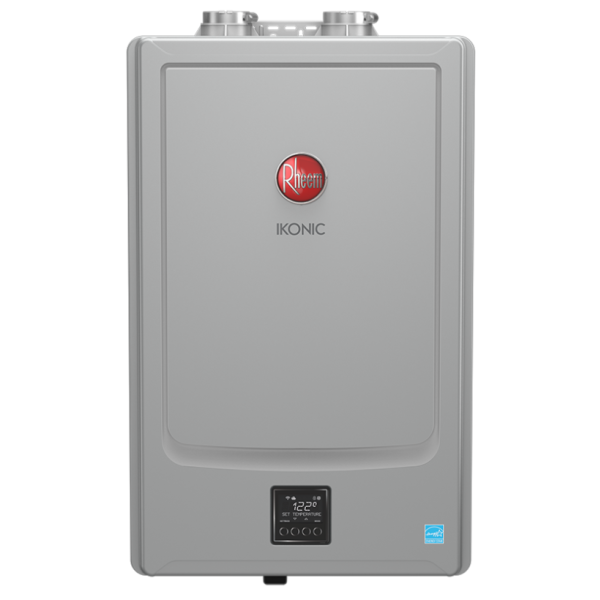
Gas tankless water heaters come in two basic designs: condensing and non-condensing. Both heat water on demand and both can supply a whole house. They differ in efficiency, venting materials, drainage, and up-front cost. Knowing how each one works makes it much easier to pick the right one for your home and your installation.
How each design works
Non-condensing
A non-condensing tankless heater has one primary heat exchanger, usually copper. The burner heats water as it passes through, and the exhaust leaves the unit very hot. Because so much heat goes out the vent, these units typically rate around 0.80–0.82 UEF (Uniform Energy Factor). For example, Rheem lists a UEF of 0.82 for its non-condensing RTG-84DVLN-3.
Condensing
A condensing unit adds a secondary heat exchanger, usually stainless steel. It captures heat from the exhaust before it leaves. That cools the flue gas enough that water vapor in it condenses, releasing more heat into the incoming water. Condensing tankless heaters commonly rate in the 0.93–0.97 UEF range. The Rheem RTGH-95DVLN-3 is one example of a condensing model.
Side-by-side comparison
| Non-condensing | Condensing | |
|---|---|---|
| Heat exchangers | One (primary) | Two (primary and secondary) |
| Typical UEF | About 0.80–0.82 | About 0.93–0.97 |
| Exhaust temperature | High | Low |
| Indoor vent material | Stainless steel (Category III) or a manufacturer concentric vent system | PVC, CPVC or polypropylene, as the manual allows |
| Condensate drain | Not usually needed | Required; a neutralizer is often recommended or required |
| Up-front unit price | Lower | Higher |
| Outdoor models | Common; no vent pipe needed | Available on some lines |
Venting: often the deciding factor
Venting can change the total job cost more than the price gap between the two heaters.
- Condensing units vent with plastic pipe, which costs less and is easier to route through walls and roofs. Many models allow long runs, and many can use a two-pipe system that brings combustion air in from outside.
- Non-condensing indoor units need a vent rated for hot exhaust. Depending on the model, that is Category III stainless steel or the manufacturer's own concentric vent. Rheem lists a 3"/5" concentric vent for the RTG-84DVLN-3. These vent parts generally cost more per foot than plastic.
- Non-condensing outdoor units mount on an exterior wall and need no vent pipe at all. In mild climates, this is often the lowest-cost whole-house tankless installation.
Never reuse an old B-vent or a water heater chimney for a tankless unit unless the manufacturer specifically allows it. Use only the vent materials and lengths listed in the installation manual.
Condensate: what condensing units need
Condensing heaters produce water as they run. The condensate is mildly acidic, so it needs a proper route to a drain. Many manufacturers and local codes call for a neutralizer kit before the drain to protect pipes and septic systems. If there is no floor drain nearby, you may need a condensate pump. In unheated spaces, the drain line must be protected from freezing.
Which one should you choose?
Condensing is usually the better fit when:
- The heater will be indoors and the vent has to run some distance.
- You want the lowest gas use over the life of the heater.
- You are replacing a tank in a basement or utility room with a floor drain nearby.
- Your area offers utility rebates that require a high UEF rating (check with your local utility).
Non-condensing is usually the better fit when:
- You live in a mild climate and can mount an outdoor model on an exterior wall.
- There is no practical way to drain condensate.
- Up-front cost matters most, and your hot water use is moderate.
- You are replacing an existing non-condensing unit with the same venting already in place.
What both types share
- Sizing: both are sized by GPM at your temperature rise. See What Size Tankless Water Heater Do I Need?
- Gas supply: whole-house units can need up to about 199,900 BTU/h. The gas line and meter must be able to supply the full input.
- Maintenance: both need periodic descaling in hard water areas. A set of tankless isolation valve kits makes flushing much easier.
- Fuel: natural gas and propane versions are sold separately, and some models are field-convertible. See our propane tankless water heaters.
Compare condensing and non-condensing models from Rheem, Noritz and Navien in our tankless water heaters collection. For more on how the parts inside work, read How Does a Tankless Water Heater Work?
Safety note: Tankless water heaters involve gas piping, combustion air, venting and electrical connections. Incorrect venting can cause carbon monoxide to enter the home. Have a licensed plumber or gas fitter install the unit to the manufacturer's manual and local code.
Frequently asked questions
Is a condensing tankless water heater worth it?
It often is for indoor installations, because it uses less gas and vents with lower-cost plastic pipe. For an outdoor installation in a warm climate, a non-condensing unit can cost less overall.
Does a condensing tankless water heater need a drain?
Yes. It produces acidic condensate that must go to a drain, often through a neutralizer. A condensate pump can be used where there is no gravity drain.
Can I vent a non-condensing tankless with PVC?
No. Non-condensing exhaust is too hot for PVC. Use the stainless or concentric vent system the manufacturer specifies.
Do condensing tankless heaters last as long?
Both types can give long service when they are sized, installed and descaled correctly. Compare the manufacturer's heat exchanger warranty for each model.