
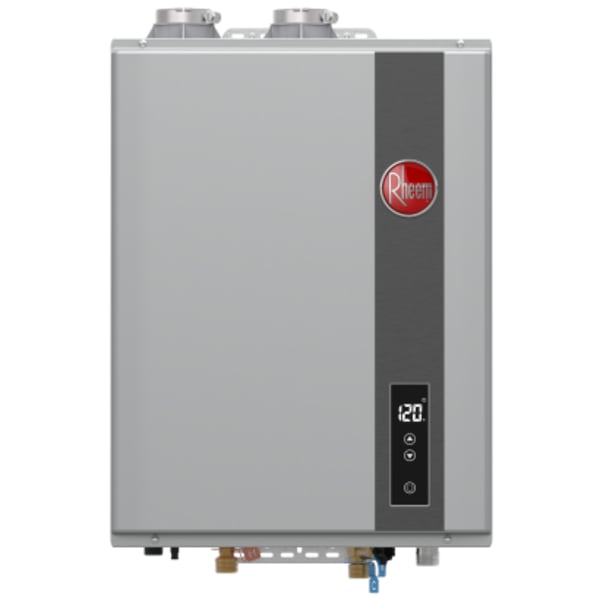
A tank water heater keeps 40 or 50 gallons of water hot around the clock, whether you use it or not. A tankless water heater takes a different approach: it heats water only when you turn on a hot water tap, and only as much as you're using. That's why tankless heaters are also called on-demand or instantaneous water heaters.
This guide explains what happens inside a tankless unit from the moment you open a faucet, the difference between gas, condensing and electric models, and the practical points to know before you buy: flow limits, the "cold water sandwich," recirculation and maintenance.
The short answer
When you open a hot water tap, cold water flows into the tankless unit. A flow sensor detects the water moving and signals the control board. The control board starts the burner (on a gas unit) or switches on the heating elements (on an electric unit). The water passes through a heat exchanger, picks up heat, and leaves the unit at the temperature you've set. When you close the tap, the flow stops and the unit shuts down. No water is stored, so there is no standby heat loss from a tank.
Inside a gas tankless water heater, step by step
- Water flow starts. You open a hot water faucet, shower or appliance. Cold water from your supply line enters the heater.
- The flow sensor detects demand. Most units need a minimum flow before they fire. The exact figure varies by model and is listed on the spec sheet, often somewhere around half a gallon per minute. Below that flow, the burner won't start.
- The fan and ignition start. The control board turns on a combustion fan to purge the chamber and supply air, then opens the gas valve and lights the burner with an electronic igniter. There's no standing pilot light on modern units.
- The burner modulates. Temperature sensors measure the incoming and outgoing water. The control board adjusts the gas valve and fan speed to deliver your set temperature. If you open a second fixture, the burner ramps up. If you close one, it ramps down.
- Heat transfers in the heat exchanger. Water flows through a coil of copper or stainless steel tubing directly above the burner flame, where it absorbs heat.
- Exhaust is vented outside. Combustion gases leave through a dedicated vent pipe, either through a wall or the roof.
- Flow stops and the unit shuts down. When you close the tap, the burner goes out. The fan may run briefly to clear the chamber.
Condensing vs non-condensing gas units
The biggest difference between gas tankless models is what they do with the heat left in the exhaust.
- Non-condensing units have a single heat exchanger. The exhaust leaves hot, so they need venting rated for high temperatures, typically stainless steel or a brand-specific concentric vent.
- Condensing units add a second heat exchanger that captures heat from the exhaust before it leaves. The exhaust cools enough that water vapor condenses out of it. This makes condensing units more efficient, and lets many of them vent with plastic pipe (such as PVC or polypropylene, as the manual allows). The trade-off is that the condensate is mildly acidic, so it needs a drain, usually through a neutralizer.
You can see both approaches in our Navien tankless water heaters collection: the NPE-2 series is condensing, and the NHW series is non-condensing. For a brand comparison, see our guide to Navien vs Rinnai tankless water heaters.
How electric tankless water heaters work
Electric tankless heaters follow the same basic sequence, but there's no burner, fan or vent. When the flow sensor detects demand, the control board switches on one or more resistance heating elements inside a heating chamber. The control modulates power to the elements to hit the set temperature.
- No venting or gas line is needed, and the units are compact.
- The electrical demand is high. Whole-house electric models typically need 240-volt service and several dedicated high-amperage circuits. Have an electrician confirm your panel can handle it.
- Output is lower than gas, especially in cold climates where incoming water is cold. Electric tankless works best in warm regions, smaller homes, or as a point-of-use heater for one bathroom or a kitchen.
See our electric tankless water heaters for examples.
Flow rate and temperature rise: why size matters
A tankless heater can't run out of hot water the way a tank can, but it can run out of capacity. Each unit can only heat a certain number of gallons per minute (GPM) by a certain number of degrees. That's why every spec sheet lists flow at a given temperature rise, for example "5 GPM at a 70°F rise."
In winter, incoming water is colder, so the heater has to work harder, and the maximum flow drops. If you run more fixtures than the unit can handle, the water temperature at the tap falls. Most units handle this by limiting flow to hold the set temperature, or by letting the temperature drop.
To work out the right size for your home, add up the GPM of the fixtures you use at the same time and match it to your regional temperature rise. Our guide What Size Tankless Water Heater Do I Need? walks through the math and includes a sizing table.
The "cold water sandwich" and other quirks
- Cold water sandwich: If you turn hot water off and back on quickly, for example between rinsing and shampooing, the water still sitting in the pipe is hot, but the heater needs a few seconds to fire again. You can get a short burst of cooler water between two hot ones. Some models reduce this with a small built-in buffer tank.
- Minimum flow: A very low trickle may not trigger the flow sensor, so the burner never fires. This can happen with a faucet barely cracked open.
- Wait time is not shorter by default: A tankless heater doesn't make hot water reach a distant faucet faster. The water still has to travel through the pipe from the heater to the tap.
Recirculation: cutting the wait for hot water
If your bathrooms are far from the water heater, recirculation keeps hot water moving through the pipes so it's near the fixtures when you need it. Many tankless models offer a built-in recirculation pump. Homes with a dedicated hot water return line can use it directly. Homes without one can often use a crossover valve under the farthest sink, which lets water return through the cold line. Recirculation is usually scheduled or triggered on demand so the unit isn't firing all day. Follow the manufacturer's piping instructions.
Gas supply and venting: the installation details
A whole-house gas tankless unit can draw up to about 199,000 BTU/h or more at full fire, far more than a typical 40,000 BTU/h tank heater. That has two practical consequences:
- The gas line must be sized for the full load. Undersized gas piping or a small meter is one of the most common causes of poor tankless performance. Many retrofits require a larger gas line from the meter.
- The vent can't simply reuse an old tank heater's flue in most cases. Tankless units use sealed, fan-assisted venting with specific materials and maximum lengths listed in the installation manual.
Safety note: Gas piping, venting, combustion air and electrical work must meet local codes and the manufacturer's instructions. Improper venting can expose occupants to carbon monoxide. Have a licensed plumber or gas fitter install and commission a gas tankless heater, and install carbon monoxide alarms in the home.
Maintenance: descaling and filters
Because water flows through narrow heat exchanger passages, mineral scale is the main enemy of a tankless heater, especially in hard water areas. Typical maintenance includes:
- Periodic descaling (flushing): Using the service (isolation) valves, a small pump circulates a descaling solution through the heat exchanger. Manufacturers often recommend this about once a year, more often with hard water. Check your manual for the schedule and approved solutions.
- Cleaning the inlet water filter screen to keep debris from restricting flow.
- Checking the air intake and vent terminations for blockages, especially after snow or on outdoor units.
- Considering water treatment such as a scale-reduction system if your water is very hard. Some warranties are affected by water quality.
Pros and cons at a glance
| Advantages | Trade-offs |
|---|---|
| Continuous hot water within the unit's flow capacity | Higher up-front cost than a tank heater |
| No standby heat loss from a stored tank | Gas line and venting upgrades are common on retrofits |
| Compact, wall-mounted, frees floor space | Output is limited by GPM and temperature rise |
| Long service life with proper maintenance | Needs periodic descaling, especially with hard water |
Is a tankless water heater right for you?
A tankless heater makes the most sense if you want endless hot water for back-to-back showers, want to reclaim floor space, and can support the gas supply or electrical load. If your gas line, venting or budget make a retrofit difficult, a high-efficiency tank heater may still be the better choice.
Weighing other options? See Heat Pump Water Heater vs Tankless: Which Is Right for Your Home? If you're comparing Navien condensing models, read Navien NPE-A2 vs NPE-S2: What's the Difference?, and if your unit shows a code, see Navien Tankless Error Codes: What They Mean and What to Check.
Ready to compare models? Browse our gas tankless water heaters. If you'd like help choosing, send us your fixture list and ZIP code and we'll help you narrow down the options.