
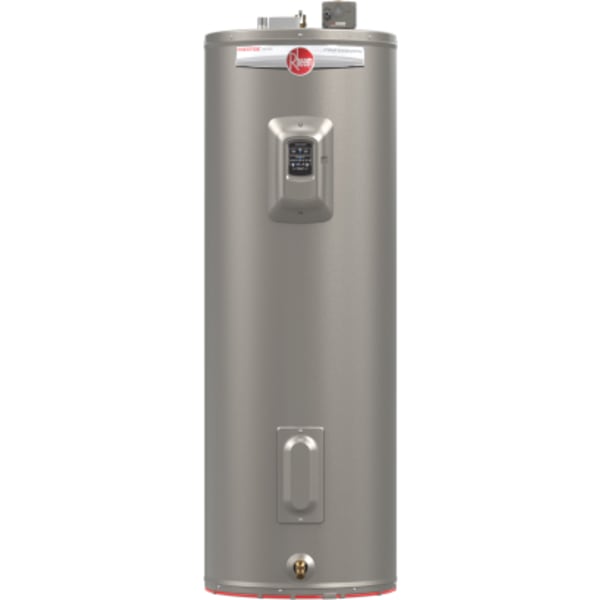
A water heater that is too small runs out of hot water halfway through the second shower. One that is too big costs more to buy, takes up more space and loses more heat while it sits. The right size depends on how many people live in the home, which fixtures run at the same time, and whether you choose a tank or a tankless unit.
This guide covers the quick household rule of thumb, the more accurate first-hour rating method for tank heaters, how sizing works for tankless, and what else changes the answer.
Quick answer: water heater size by household
For a standard storage tank, these ranges are a common starting point. They assume typical fixtures and a normal morning rush. Gas tanks recover faster than electric tanks, so a gas home can often use a slightly smaller tank.
| People in the home | Gas tank | Electric tank |
|---|---|---|
| 1–2 | 30–40 gallons | 30–40 gallons |
| 2–3 | 40 gallons | 40–50 gallons |
| 3–4 | 40–50 gallons | 50–66 gallons |
| 5 or more | 50+ gallons | 66–80 gallons |
Use this table to narrow your search, then confirm with the first-hour rating method below. If your family takes back-to-back showers or you have a large soaking tub, size up.
The better method: match first-hour rating to your peak hour
Tank size alone does not tell you how much hot water you get. The number that matters is the first-hour rating (FHR): how many gallons of hot water the heater can deliver in one hour, starting with a full tank. It combines tank size with how fast the burner or elements reheat the water. The FHR is printed on the yellow EnergyGuide label and on the manufacturer's spec sheet.
Step 1: Estimate your peak-hour demand
Pick the busiest hour of the day in your home, usually a weekday morning. List every hot water use in that hour and add up the gallons. The U.S. Department of Energy uses these typical figures:
| Use | Hot water per use (approx.) |
|---|---|
| Shower | 10 gallons |
| Shaving | 2 gallons |
| Hand and face washing | 4 gallons |
| Hand dishwashing or food prep | 4 gallons |
| Automatic dishwasher | 6 gallons |
| Clothes washer (hot or warm) | 7 gallons |
Example: Three showers (30 gallons), one shave (2), two hand washes (8) and a dishwasher run (6) add up to a peak-hour demand of about 46 gallons.
Step 2: Pick a heater with a matching FHR
Choose a model whose first-hour rating is equal to or slightly above your peak-hour number. In the example above, look for an FHR in the high 40s or more. Going far above it adds cost and standby loss without much benefit.
Why gas and electric differ
Recovery rate is how many gallons a heater can reheat per hour. You can estimate it with a simple formula: gallons per hour ≈ (BTU/h output) ÷ (8.33 × temperature rise in °F). A 4,500-watt electric element puts out about 15,350 BTU/h, so at a 90°F rise it recovers roughly 20 gallons per hour. A 40,000 BTU/h gas burner at about 78% efficiency delivers around 31,000 BTU/h, which recovers roughly 40 gallons per hour at the same rise. That is why a 40-gallon gas tank and a 50-gallon electric tank often have similar first-hour ratings.
Sizing a tankless water heater instead
Tankless units do not store water, so they are sized by flow rate (gallons per minute) at your temperature rise, not by gallons. Add up the GPM of the fixtures you run at the same time, find your winter incoming water temperature, and pick a unit that can deliver that flow at that rise. Our full walkthrough is in What Size Tankless Water Heater Do I Need?, and you can compare models in our tankless water heaters collection.
Other factors that change the size
- Incoming water temperature. Homes in northern states start with colder water, so the heater has to work harder. Recovery and tankless flow drop as the temperature rise goes up.
- Large tubs and body sprays. A big soaking tub can take 25 gallons or more of hot water at once. Size the tank so it can fill the tub with water to spare.
- Low-flow fixtures. Newer showerheads use less water, which can let you stay at a smaller size.
- Space and access. Measure the height, width and door openings. Tall and short versions of the same capacity exist for low ceilings and tight closets.
- Fuel and venting. Replacing gas with gas or electric with electric is usually simplest. Switching fuel can mean a new gas line or a new 240V circuit.
- Federal efficiency rules. Under the 2015 DOE standards, residential tanks larger than 55 gallons generally need heat pump technology (electric) or condensing technology (gas). That affects price and installation if you are moving up past 55 gallons.
A note on replacement cost
The final cost of a new water heater depends on more than the tank. Fuel type, venting changes, code updates (such as expansion tanks, drain pans, seismic straps or a new T&P discharge line), permits, haul-away and labor in your area all add to the price. Getting the size right avoids paying for capacity you do not need, and avoids a second replacement because the first one was too small.
Where to start shopping
- Residential gas tank water heaters: atmospheric, powered damper, power vent and direct vent models from 29 to 98 gallons.
- Residential electric tank water heaters: 240V models in short, medium and tall heights.
- Rheem 40 gallon water heaters: the most common size for two to three people.
- Rheem 50 gallon water heaters: a common choice for three to five people.
Safety note: Gas piping, venting and 240V electrical work must meet local code. Have a licensed plumber, gas fitter or electrician install or replace your water heater, and pull a permit where one is required.
Frequently asked questions
What size water heater do I need for a family of four?
A family of four usually needs a 40–50 gallon gas tank or a 50–66 gallon electric tank. Confirm it by adding up your peak-hour hot water use and choosing a first-hour rating that matches.
Is a bigger water heater always better?
No. A tank that is much larger than your peak demand costs more up front, loses more heat in standby and takes more space. Size to your busiest hour, with a small margin.
Where do I find the first-hour rating?
It is on the yellow EnergyGuide label on the tank and in the manufacturer's spec sheet. It is listed in gallons.
Does a tankless water heater ever run out of hot water?
It does not run out the way a tank does, but it has a flow limit. If you open more fixtures than it can heat at your temperature rise, the water gets cooler. That is why tankless is sized by GPM.